AI-Powered IoT Framework for Vehicle Breakdown Alerts: Advancing Digital Social Transformation in Intelligent Transportation Systems
DOI:
https://doi.org/10.61503/AITST.v1I1.3Keywords:
Artificial Intelligence, Internet of Vehicles, Social Internet of Vehicles, IoT, Intelligent Transportation Systems, Vehicle Breakdown AlertsAbstract
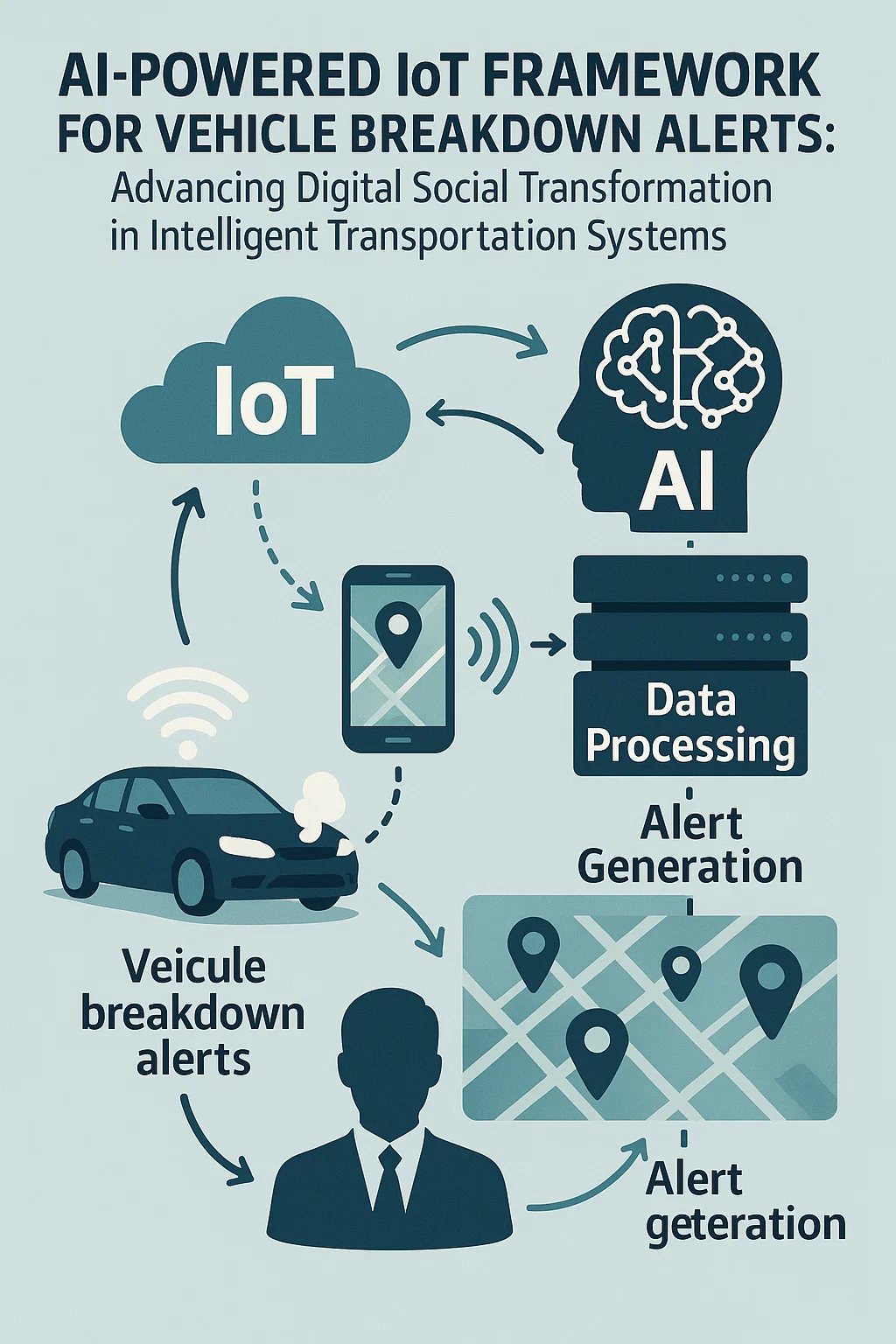
Purpose— Artificial Intelligence (AI) and Internet of Things (IoT) technologies are changing the transportation systems into intelligent, socially connected ecosystems. This study presents an AI-empowered Internet of Vehicles (IoV) framework for real-time vehicle breakdown information sharing, designed to enhance digital social transformation in mobility.
Study Design/methodology/approach— The proposed model enables vehicles to detect breakdown events via onboard sensors and AI-driven diagnostics, automatically generating geolocation-based alerts. These alerts are transmitted through vehicular clouds and roadside units (RSUs) to other vehicles, service stations, and the driver’s designated social network (e.g., family, friends, office contacts). The system was tested using twenty simulated vehicles in an urban setting using the Simulation of Urban Mobility (SUMO) platform and OpenStreetMap (OSM) data.
Findings— Findings indicate that the AI-IoT solution is highly effective in terms of reducing the response time and enhancing communication coverage as opposed to traditional breakdown reporting techniques.
Research Practical Implications— The framework explains how the AI can augment the Social Internet of Vehicles (SIoV) by attaining context-aware, proactive, and socially connected safety interventions. It is designed to enhance digital social transformation in mobility.
Originality/value— This study presents an AI-empowered Internet of Vehicles (IoV) framework for real-time vehicle breakdown information sharing. The research falls within the new field of Intelligent Transportation Systems (ITS) based on AI and the role of socially intelligent networks in the evolution of transportation safety, efficiency, and user experience.
References
Aftab, M., Syed, K. B. S., & Katper, N. A. (2017). Exchange-rate volatility and Malaysian-Thai bilateral industry trade flows. Journal of Economic Studies, 44(1), 99-114.
Ahmed, A., & Katpar, N. K. (2019). Reasons of Israeliyat for arriving into the Quranic Interpretation and their Effects Aziz Ahmed*: اسرائیلی روایات کا کتبِ تفسیر میں آنے کے اسباب اور ان کے اثرات. Al-Aijaz Research Journal of Islamic Studies & Humanities, 3(1), 239-249.
Ashfaq, A., Imran, H., Nehal, N., Shamim, M., Asif, A., Ikhlaque, M., & Katper, N. (2023). Interest of Women in the Tourism Sector and How to Empower Them. In Women’s Empowerment Within the Tourism Industry (pp. 427-441). IGI Global Scientific Publishing.
BROHI, I., ALI, N., KOONDHAR, M., SHAIKH, I., KATPER, N., & Shah, A. (2018). An assessment of proximity technology adoption from a user’s perspective. Sindh University Research Journal (Science Series), 50(3D), 220-223.
BROHI, I., ALI, N., SHAIKH, I., KATPER, N., MAHER, Z., CHANNAR, S., & SHAH, A. (2018). A Review of Near Field Communication Process: How do it works?. Sindh University Research Journal (Science Series), 50(3D), 237-240.
Channa, Z., Katpar, N. K., & Rahoo, L. A. (2019). Analysis of Islamic Banking Electronic Services Factors on Loyalty of Customers. Al-Aijaz Research Journal of Islamic Studies & Humanities, 3(1), 388-394.
Jamali, K. A., Katper, N., & Khoso, I. (2022). INVESTIGATING DETERMINANTS OF CUSTOMER RETENTION IN ISLAMIC BANKING: AN EMPIRICAL INVESTIGATION IN THE PAKISTANI PARADIGM. INTERNATIONAL JOURNAL OF MODERN SCIENCES AND MULTIDISCIPLINARY STUDIES (IJMSMS), 1(01), 69-85.
Jamali, K. A., Katper, N., Khaskhelly, F. Z., & Khaskhelly, Y. (2024). University Incubators: Cultivating Innovation for a Flourishing Entrepreneurial Society. International Research Journal of Management and Social Sciences, 5(3), 151-165.
Junejo, I., Ali, U. A., Qureshi, M. A., Katper, N., Rahoo, L. A., & Saraih, U. N. B. (2023). MEDIATING ROLE OF FIRM SIZE FOR ETHCIAL E-PROCUREMENT IMPLEMENTATION: EMPLOYEE PERCEPTION FROM SMES. Russian Law Journal, 11(7S), 108-117.
Katper, N. A. (2018). Determinants and Managerial Trustworthiness in The Capital Structure and Debt Maturity: Evidence from Shariah Compliant and Conventional Firms in Pakistan (Doctoral dissertation, University of Malaya (Malaysia)).
Katper, N. K., Azam, M., Karim, N. A., & Zia, S. Z. (2019). Behavioral biases and investors’ decision-making: The moderating role of socio-demographic variables. International Journal of Financial Engineering, 6(03), 1950020.
Katper, N. K., Chaudhry, N. I., Tunio, M. N., & Ali, M. A. (2020). Impact of leadership style and organizational culture on organizational commitment. Sukkur IBA Journal of Management and Business, 7(1), 92-106.
Katper, N. K., Madun, A., & Hussain, N. (2019). Sector-wise analysis for debt maturity structures in Shariah-compliant and conventional firms of Pakistan. The International Research Journal of Usooluddin, 3(1), 27-42.
Katper, N. K., Madun, A., & Katper, S. A. (2021). Sector-wise analysis for capital structures and managerial behavior in Shariah-compliant and conventional firms of Pakistan. International Research Journal of Management and Social Sciences, 2(2), 192-206.
Katper, N. K., Madun, A., & Syed, K. B. S. (2015). Does shariah compliance lead to managerial trustworthiness? Evidence from empirical analysis of capital structure of shariah and non-shariah firms in Pakistan. Journal of Applied Economic Sciences, 10(7), 1028-1045.
Katper, N. K., Shaikh, S. S., & Ali, N. I. (2018). The Role of Manager: A Common Paradigm On Managerial Behavior In The Light Of Islamic Principles. Journal of Grassroots, 52(1).
Katper, N. K., Shaikh, S. S., Anand, V., & Ali, N. I. (2018). Analysing the impact of managerial ownership on the performance of shariah-compliant firms in Pakistan. International Business Research, 11(11), 55-66.
Katper, N. K., Tunio, M. N., Hussain, N., Junejo, A., & Gilal, F. G. (2020). COVID-19 crises: global economic shocks vs Pakistan economic shocks. Advances in Science, Technology and Engineering Systems Journal, 5(4), 645-654.
Katper, N., Salman, S. M., & Mohy-ud-Din, K. (2024). Unleashing the mechanism in green finance, corporate social responsibility and shareholders wealth: Insight from quantile GMM. Global Business Review, 09721509241276254.
Khand, S., Anand, V., Qureshi, M. N., & Katper, N. K. (2019). The performance of exponential moving average, moving average convergence-divergence, relative strength index and momentum trading rules in the Pakistan stock market. Indian journal of science and technology, 12(26), 1-22.
Shah, E., Ali, S., & Katper, N. (2023). An overview of women empowerment policy with a social justice lens and frugal innovation. Frugal innovation and social transitions in the digital era, 123-132.
Shaikh, G. M., Karim Katpar, N., Kalhoro, M., Abro, Y. K., & Phanwar, G. A. (2019). Do behavioral biases in gender differences affect investment decisions. Sociology International Journal, 3(4), 326-336.
Shaikh, S. S., Shah, S. A. S., Katpar, N. K., & Shah, S. K. B. (2019). Factors affecting work-life balance of women working in NGOs of Pakistan. The Women-Annual Research Journal of Gender Studies, 11(11).
Shaikh, S. S., Talpur, U., Muhammad Khuwaja, F., & Katper, N. K. (2018). Assessing the effect of personal and job resources on work engagement of university teachers. International Journal of Advanced and Applied Sciences, 5(11), 100-109.
Shaikh, S. S., Talpur, U., Muhammad Khuwaja, F., & Katper, N. K. (2018). Assessing the effect of personal and job resources on work engagement of university teachers. International Journal of Advanced and Applied Sciences, 5(11), 100-109.
SYED, K. B. S., ZAINIR, F. B., ISA, M., & KATPER, N. K. (2018). Integrating Reputational Considerations in the Empirical Analysis of Dividend Smoothing Policy of Emerging Market Firms-A Quantile Regression Approach. Journal of Applied Economic Sciences, 13(2).
Tunio, M. N., Shaikh, E., & Lighari, S. (2021). Multifaceted perils of the Covid-19 and implications: A Review. Studies of Applied Economics, 39(2).
Tunio, M. N., Shaikh, E., Katper, N. K., & Brahmi, M. (2023). Nascent entrepreneurs and challenges in the digital market in developing countries. International Journal of Public Sector Performance Management, 12(1-2), 140-153.
Tunio, M. N., Yusrini, L., Shah, Z. A., Katper, N., & Jariko, M. A. (2021). How hotel industry cope up with the COVID-19: An SME Perspective. Etikonomi, 20(2), 213-224.
Downloads
Published
Issue
Section
License
Copyright (c) 2025 Muhammad Sohaib (Author)

This work is licensed under a Creative Commons Attribution 4.0 International License.
How to Cite